How Can Textile Mills Implement AI? A Practical Guide to AI in Textile Manufacturing
Discover how textile mills can implement AI for quality inspection, predictive maintenance, production planning, dyeing optimization, and textile exports.
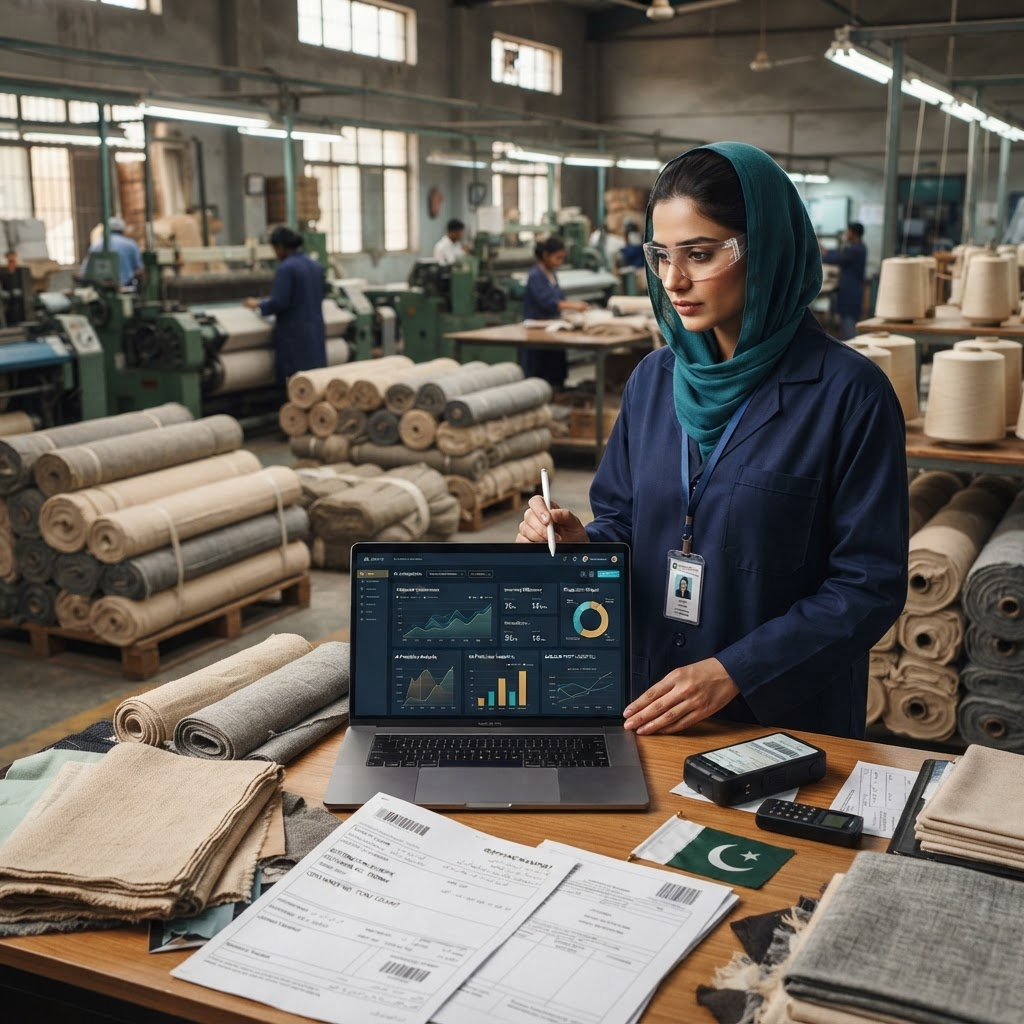
How Can Textile Mills Implement AI? A Practical Guide to AI in Textile Manufacturing
Artificial intelligence (AI) is transforming textile manufacturing by helping mills improve production efficiency, reduce fabric defects, optimize energy consumption, predict machine failures, and make better business decisions. From spinning and weaving to dyeing, finishing, and textile exports, AI offers opportunities to modernize traditional manufacturing operations without necessarily replacing existing machinery.
But how can textile mills actually implement AI? Which AI technologies deliver the greatest operational value? And how can textile manufacturers begin their AI transformation without investing heavily in infrastructure?
This guide explains the practical applications, implementation strategies, benefits, and challenges of adopting artificial intelligence in textile manufacturing.
What Is AI in Textile Manufacturing?
AI in textile manufacturing refers to the use of artificial intelligence, machine learning, computer vision, predictive analytics, and intelligent automation to improve industrial processes and business operations.
Unlike conventional automation, which follows predefined instructions, AI systems can analyze data, recognize patterns, predict potential problems, and support decisions based on historical and real-time information.
For textile mills, AI can be applied across multiple production stages, including:
AI implementation does not necessarily require a completely new factory. Many applications can operate alongside existing textile machinery, ERP systems, and production management processes.
10 Practical Ways Textile Mills Can Implement AI
1. AI-Powered Textile Quality Inspection
Fabric quality inspection is one of the most promising applications of AI in textile manufacturing.
Traditional inspection often depends on human operators identifying defects during fabric examination. AI-powered computer vision systems use industrial cameras and trained algorithms to identify textile defects automatically.
These systems can detect:
AI inspection systems can help mills detect defects earlier, improve inspection consistency, and reduce the risk of defective fabric reaching customers.
2. Predictive Maintenance for Textile Machinery
Unexpected machine breakdowns can disrupt production schedules, increase maintenance costs, and delay export orders.
AI-based predictive maintenance analyzes operational information such as:
Machine learning models can identify abnormal patterns and estimate when equipment may require maintenance.
For example, an AI system could identify unusual vibration patterns in a spinning machine or detect abnormal operating conditions in a weaving machine.
Instead of relying entirely on reactive maintenance, mills can move toward condition-based and predictive maintenance.
3. AI for Spinning and Yarn Manufacturing
AI can support spinning mills by analyzing production data and identifying relationships between operating conditions and yarn quality.
Potential applications include:
AI models can analyze parameters such as fiber properties, machine speed, twist, humidity, and historical laboratory results to support process optimization.
The objective is to help spinning mills achieve more consistent yarn quality while reducing waste and production interruptions.
4. AI in Dyeing and Wet Processing
Dyeing and wet processing are particularly suitable for data-driven optimization because multiple variables influence the final product.
These variables include:
AI can analyze historical dyeing recipes, laboratory results, production parameters, and shade approvals to recommend improved process conditions.
Practical applications include:
AI-assisted process control can help reduce repeated dyeing, unnecessary chemical consumption, and shade variation.
However, AI recommendations should be validated by experienced dyeing professionals before being applied to production.
5. AI-Based Production Planning and Scheduling
Production planning is a complex challenge for textile mills handling multiple customers, machines, products, and delivery deadlines.
AI can support production planners by analyzing:
An AI-powered production planning system can help identify scheduling conflicts, recommend production sequences, and highlight orders at risk of delay.
For example, a towel manufacturing mill could use AI to coordinate weaving, dyeing, finishing, and packing schedules across multiple export orders.
The result is better production visibility, more informed scheduling, and improved utilization of available capacity.
6. AI for Energy and Water Optimization
Energy and water are significant operational considerations in textile manufacturing, particularly in spinning, dyeing, finishing, and processing facilities.
AI can analyze consumption patterns and identify opportunities to improve resource efficiency.
Possible applications include:
AI systems can identify abnormal consumption patterns and recommend operational adjustments.
For wet processing mills, AI can also help evaluate how process conditions influence water, energy, and chemical consumption.
These applications can support sustainability initiatives, improve resource management, and strengthen environmental performance reporting.
7. AI for Inventory and Raw Material Management
Textile mills manage multiple types of inventory, including cotton, yarn, dyes, chemicals, packaging materials, fabric, and finished products.
AI can help improve inventory management by analyzing:
AI-powered forecasting can support better purchasing decisions and reduce the risk of material shortages or excess inventory.
For textile exporters, this can improve coordination between procurement, production, merchandising, and shipping departments.
8. AI for Export Orders and Documentation
AI implementation should not be limited to the production floor.
Textile mills can also implement AI across merchandising, export operations, and customer communication.
AI assistants can help with:
For example, an AI Export Assistant could analyze a buyer's towel specification, extract dimensions, GSM, composition, colors, packaging requirements, and quantities, then prepare a structured quotation draft for the merchandising team.
Human employees should verify commercial terms, technical specifications, and official shipping documents before approval.
9. AI-Powered Business Intelligence
Textile mills generate valuable operational data through ERP systems, production records, laboratory reports, sales databases, and financial information.
AI-powered business intelligence can convert this information into actionable insights.
Management can use AI to investigate questions such as:
Instead of depending entirely on manually prepared reports, managers can interact with AI-powered dashboards and analytical assistants.
10. AI Agents for Textile Mills
The next stage of AI adoption involves AI agents.
An AI agent is a software system designed to perform specific tasks, use approved tools, retrieve information, and execute workflows under defined permissions.
Textile mills can deploy specialized AI agents for different departments.
| AI Agent | Primary Function |
|---|---|
| AI Production Agent | Monitor production information and report operational issues |
| AI Quality Agent | Analyze quality reports and identify recurring defects |
| AI Maintenance Agent | Track maintenance schedules and equipment alerts |
| AI Merchandising Agent | Analyze orders and assist with buyer communication |
| AI Export Agent | Support quotations and export documentation |
| AI Procurement Agent | Analyze material requirements and supplier information |
| AI Marketing Agent | Generate product catalogs and marketing content |
| AI Management Agent | Prepare business summaries and management reports |
These agents can operate as digital assistants for employees rather than replacing the expertise of production managers, engineers, merchandisers, and textile professionals.
The most effective implementation combines AI capabilities with human supervision, reliable information, and clear operational responsibilities.
How Can a Textile Mill Start Implementing AI?
A textile mill does not need to implement every AI application simultaneously.
The most practical approach is to begin with a specific operational problem and expand gradually.
Step 1: Identify the Biggest Operational Problem
Start by identifying where the mill loses the most time, money, material, or productivity.
Examples include:
Choose one measurable problem rather than implementing AI simply because it is a new technology.
Step 2: Evaluate Existing Data
AI depends on reliable information.
Review the data already available in:
Even a mill with limited digital infrastructure may already possess useful historical data.
The first requirement is to organize and standardize this information.
Step 3: Select the Right AI Solution
Different problems require different technologies.
| Business Problem | Appropriate AI Technology |
|---|---|
| Fabric defect detection | Computer vision |
| Machine failure prediction | Machine learning and sensor analytics |
| Production forecasting | Predictive analytics |
| Dye recipe optimization | Machine learning and process analytics |
| Document processing | AI document extraction |
| Buyer communication | AI assistants and agents |
| Management reporting | AI analytics and natural-language interfaces |
The solution should fit the mill's existing processes, equipment, data availability, and investment capacity.
Step 4: Implement a Pilot Project
Begin with one machine, production line, department, or workflow.
For example:
A pilot allows the mill to evaluate accuracy, usability, operational impact, and financial feasibility before expanding.
Step 5: Measure Results
Every AI project should have measurable performance indicators.
Relevant KPIs include:
Compare results against the baseline established before implementation.
Step 6: Train Employees and Expand
AI implementation requires employee participation.
Production managers, engineers, quality inspectors, maintenance teams, merchandisers, and management should understand how the system works and when its recommendations require verification.
Once the pilot demonstrates value, expand the solution to additional machines, departments, or production facilities.
AI Implementation Architecture for Textile Mills
A practical AI infrastructure can be built in layers.
| Infrastructure Layer | Purpose |
|---|---|
| Machine and operational data | Collect production, quality, sensor, and ERP information |
| Data integration | Connect existing systems and standardize information |
| AI intelligence | Run predictive models, computer vision, and AI agents |
| Employee interfaces | Provide dashboards, alerts, and AI assistants |
| Management intelligence | Deliver KPIs, forecasts, and operational insights |
| Governance and security | Manage access, approvals, privacy, and system reliability |
For real-time manufacturing applications, edge computing can process information close to the production equipment, while cloud infrastructure can support centralized analytics, model management, and reporting.
Not every AI application requires industrial IoT sensors. Document processing, export assistants, management reporting, and many forecasting applications can begin with existing digital records.
What Are the Challenges of Implementing AI in Textile Mills?
Despite its potential, AI implementation involves practical challenges.
Data Quality
Incomplete, inconsistent, or inaccurate production records can reduce AI reliability.
Legacy Machinery
Older textile machines may lack digital interfaces or compatible sensors. Retrofitting and integration may be necessary for certain applications.
Investment Costs
Industrial cameras, sensors, computing equipment, software integration, and specialist services can require capital investment.
Workforce Skills
Employees need training to use AI systems effectively and interpret their recommendations.
Cybersecurity
Connected manufacturing systems require appropriate access controls, network security, data protection, and operational safeguards.
Reliability and Human Oversight
AI predictions are not always correct. Critical production, maintenance, quality, and safety decisions should retain appropriate human supervision.
How Much Does AI Implementation Cost for a Textile Mill?
There is no universal AI implementation cost.
Investment depends on the application, number of machines, existing digital infrastructure, software requirements, integration complexity, and scale.
A useful way to approach AI investment is through three implementation levels:
| Level | Implementation Approach |
|---|---|
| Starter | AI assistants, document automation, reporting, and basic analytics |
| Intermediate | ERP integration, production forecasting, quality analytics, and selected machine monitoring |
| Advanced | Industrial computer vision, sensor-based predictive maintenance, process optimization, and integrated AI infrastructure |
Textile mills can begin with relatively low-cost digital AI applications before investing in more complex industrial systems.
The correct investment decision should be based on measurable business value, not technology expenditure alone.
The Future of AI in Textile Manufacturing
The future of textile manufacturing will increasingly combine industrial automation, AI, connected machinery, digital systems, and intelligent business operations.
Emerging opportunities include:
The transformation will not happen through a single technology or software installation.
It will develop through interconnected systems that allow textile mills to collect information, improve processes, make better decisions, and respond more efficiently to changing customer requirements.
How TEP Supports AI Transformation in the Textile Industry
Textile Exporters Pakistan (TEP) is developing a vision for **Digital AI-Infrastructure for the Textile Industry**.
Rather than focusing exclusively on traditional textile trading or factory automation, TEP aims to connect textile businesses with digital intelligence, AI-powered tools, industry information, and practical technology adoption.
The broader vision includes:
This approach recognizes that textile transformation involves not only machines and production processes but also business operations, knowledge, exports, and industry connectivity.
Explore the platform: **[Textile Exporters Pakistan](https://TextileExportersPakistan.com)**
Frequently Asked Questions (FAQs)
How can textile mills implement AI without replacing existing machinery?
Textile mills can begin with AI applications that use existing production records, ERP data, quality reports, and business documents. For machine-level applications, compatible sensors, cameras, or integration systems may be added where required.
Which AI application is best for textile mills?
AI-powered quality inspection and predictive maintenance are strong candidates for manufacturing-focused pilots. AI export assistants, document automation, and management reporting can also provide practical value without extensive machinery modifications.
Can small textile mills implement AI?
Yes. Small and medium-sized mills can begin with affordable AI tools for reporting, document processing, marketing, order analysis, and operational planning. More advanced industrial AI can be introduced as business requirements and investment capacity develop.
Is AI replacing textile engineers and production managers?
AI is primarily a decision-support and automation technology. Textile engineers, production managers, quality professionals, and experienced operators remain essential for interpreting results, validating recommendations, and managing manufacturing operations.
What is the difference between AI and automation in textile manufacturing?
Traditional automation executes predefined instructions. AI can analyze data, recognize patterns, predict outcomes, and adapt recommendations based on information. Combining AI with automation can enable more intelligent manufacturing processes.
What is the first step toward AI transformation in a textile mill?
The first step is identifying a measurable operational problem, evaluating available data, selecting a suitable AI application, and implementing a controlled pilot project.
Conclusion: AI Is Becoming a Strategic Advantage for Textile Mills
Artificial intelligence offers textile manufacturers a practical opportunity to improve productivity, quality, resource efficiency, and business performance.
The most successful AI implementations will not necessarily be the most expensive or technologically complex. They will be the solutions that address real manufacturing problems, integrate effectively with existing operations, and deliver measurable results.
For textile mills, the journey toward AI-powered manufacturing begins with one important decision: identifying where intelligent technology can create the greatest operational value.
The future of textile manufacturing is not simply automated. It is increasingly intelligent, connected, and data-driven.
---
**Published by Textile Exporters Pakistan (TEP)**
Digital AI-Infrastructure for the Textile Industry of Pakistan
Website: https://TextileExportersPakistan.com
Related Articles
How to Calculate Textile Export Costing and FOB Prices: A Practical Guide
Learn textile export costing, FOB price calculation, material consumption, export charges, profit margin formulas, and quotation tips for Pakistani textile exporters.
The EU Digital Product Passport: What Pakistani Textile Exporters Need to Know Before 2027
The EU's Digital Product Passport will become mandatory for textiles by 2027–2028. Here's what it requires, the real timeline, and how Pakistani exporters can prepare.
Why 60-70% of Letters of Credit Get Rejected — And How Textile Exporters Can Avoid It
Most letter of credit rejections have nothing to do with the goods shipped — they are paperwork mismatches. Learn why LC discrepancies happen in textile exports and how to prevent payment delays.